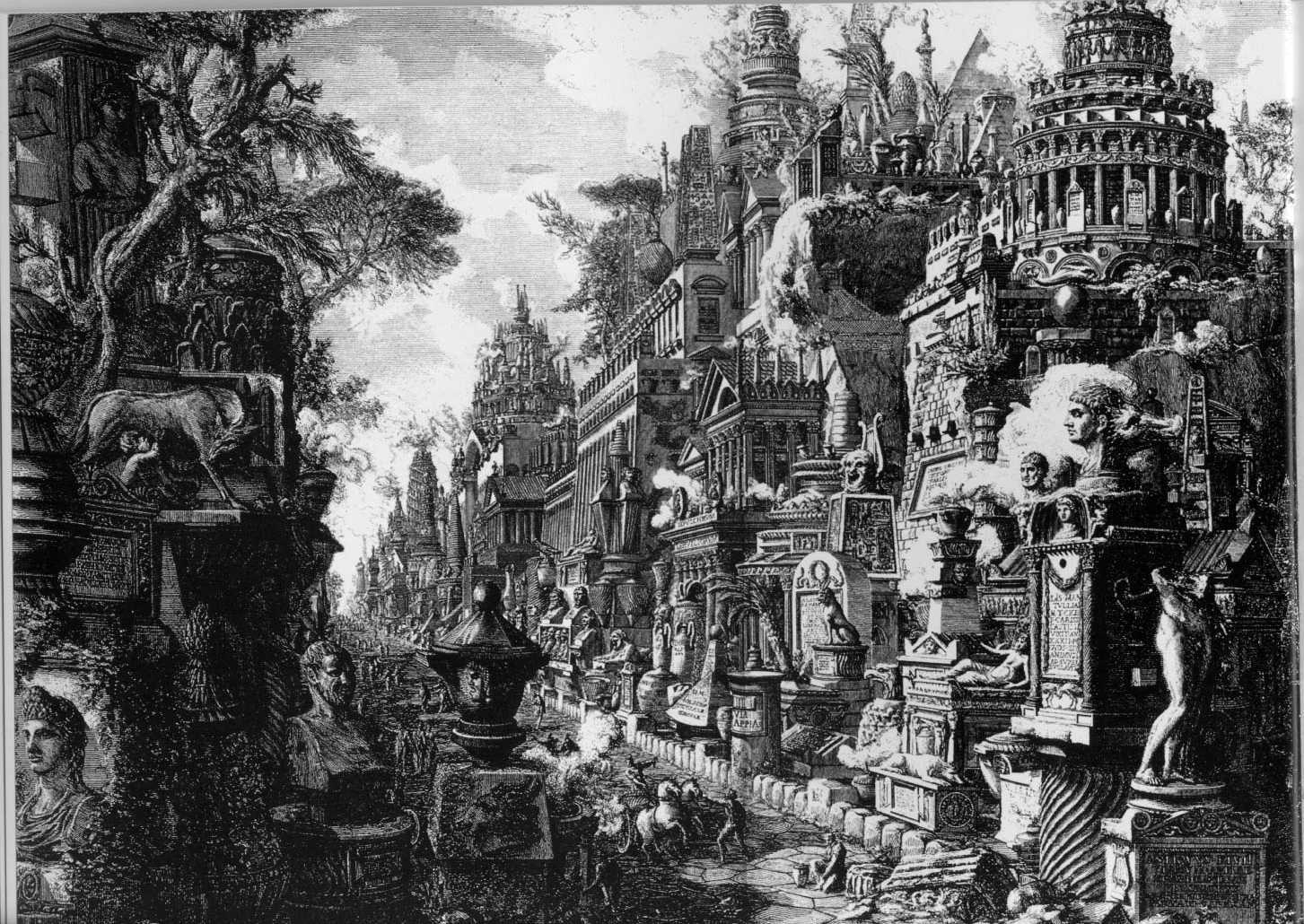
Other objects
brought to life from the etchings include Brobdingnagian urns festooned with
griffins and other fantastic creatures, elaborate candelabra and lost
antiquities. Fragments of designs are
scattered on tables in the style of an 18th century wunderkammern,
testimony to Piranesi’s art but also the technicians’ skill and science
bringing these pieces to life from the black and white prints.Thursday, April 11, 2013
Virtually Piranesian
Other objects
brought to life from the etchings include Brobdingnagian urns festooned with
griffins and other fantastic creatures, elaborate candelabra and lost
antiquities. Fragments of designs are
scattered on tables in the style of an 18th century wunderkammern,
testimony to Piranesi’s art but also the technicians’ skill and science
bringing these pieces to life from the black and white prints.Tuesday, July 26, 2011
Le Dingbat Nouveau
In “Los Angeles: The Architecture of Four Ecologies” Reyner Banham popularized “dingbat” to describe the horrendously bland and ubiquitous developer driven apartment buildings that cover the flats of LA. Far away from the high design inhabiting the hills, canyons and beaches preferred by architects of the Case Study program, these clunky rent generating machines, consisting of 4, or 8, or 12 studio, 1-bedroom and two bedroom units were often the first arrival point for many recently minted Angelenos. Their desperate designers tried to compensate for the relentless mediocrity with a swanky name (The Versailles, The Lido, Beverly Arms), and, in extreme cases, a fancy metal mansard roof, an oversized swag lamp in the entry court, a couple of cartouches and…hold for it… glitter stucco. Like the romanticized bungalow courtyards of Nathanael West’s “Miss Lonely Hearts” they are now part of Hollywood's background scenery. They are comfortably ensconced as an easy shorthand for a certain despairing and striving social strata of Los Angeles – in the films these sad sack dumps are occupied by grifters or screenwriters.
San Diego has its own home grown version of the dingbat, thanks to wise guy developer Ray L. Huffman. North Park is blighted by these 6-pack, 8-pack and 12-pack apartment buildings. Even today realtors tout Huffman’s expertise in cramming as many units as possible into the ugliest box possible. There were few attempts to upscale or sweeten the relentless efficiency of these ghetto creators. San Diego’s dingbats lack even a veneer of style. In their defense, they are the mainstay of affordable housing in San Diego. They are just ugly and cheap.
Well, those were different times, right? Well, yes and no. We have now what I call the Dingbat Nouveau – new apartment and condo buildings no doubt lauded by fans of San Diego’s City of Villages plan. Denser and bigger these new buildings are thankfully more aware of the politesse required to shoehorn denser and bigger into the fine-grained neighborhoods of North Park, Hillcrest and Mission Hills.
Well, at least some of the time.
Here are some pics of some winners… and some losers. Let me know what you think. Are there new dingbats in your neighborhood?
Saturday, July 9, 2011
Esther McCoy Appreciation

The MAK Center in West Hollywood has some great events this summer - to celebrate his centennial, a July 23 tour of John Lautner houses and an appreciation of Esther McCoy, the architectural critic and historian who Reyner Banham famously called "the mother of us all." (He was talking about architectural historians, so I imagine "us" was a pretty exclusive party.) McCoy's role championing the remarkable activities of a few architects in a nascent Los Angeles architecture scene cannot be overestimated. Far from the usual suspects of high culture in New York or Europe her words, and the images of Julius Schulman and Marvin Rand captured the world's imagination.
Wednesday, July 6, 2011
'90s Funky Po Mo in Normal Heights
Bit of Venice style funk down the street from the Carmelite Monastery on Hawley. I'll do some research and find out more. Very Bay Area vibe. I like the picnic set with the Mission Valley view.
Saturday, July 2, 2011
The Charmer: Its Beauty and the Moonlight Overthrew Me
Clean and white against the cacophonous funk of Midtown, Jonathan Segal’s latest venture, the Charmer, could be a lost piece of Stuttgart’s famous Weissenhofsiedlung of 1927. The Bauhaus inspired architects of the Weimar Republic were exploring industrial and scientifically based models of living to replace traditions challenged by technology and rapid urban growth. Here, San Diego’s most visible architect/developer continues to explore the intricacies of traditional row homes and, in these economically anorexic times, maintain a positive spreadsheet. Corbu and Mies may have asked “architecture or revolution?” but Segal might ask “architecture or recession?”
Crisp volumes etched with elegantly proportioned black window frames step down a hillside site towards busy, one-way India Street. Here in Midtown India loses its Little Italy charm and functions more as a freeway access road. This nowhere land non-appeal has invited the appearance of a couple of outliers of hipdom – the Starlight, the Regal Beagle and retro-dive bar Aero among others. They blend in well with long time neighborhood stalwarts, El Indio and Shakespeare & Co. Charming in their own way, the bungalows and ‘50s apartments, car repair and other gritty services provides Segal’s project a messy counterpoint to the self contained “calme, luxe et volupte” qualities of this neo-modernist exercise.
From the street, the Charmer provides few clues to the individual unit layouts, aiming for a larger compositional unity with those large open windows, open walkways, balconies and expanses of white stucco, while the enigmatic entries within the court coyly declaim their physical separation. Here the ghost of Segal’s previous etudes on the row house model are apparent - and these post-modern and neo-traditional elements rub shoulders well with Segal’s new International Style moves.
The elongated proportions of the entries, flanked as they are by skinny cypresses, betray a certain soignee Hollywood Regency elan, but the atavistic simplicity of the ka’bah reminiscent black asphalt shingle covered cubes immediately sobers up any playfulness. Where a ‘80s architect may have joked it up with a fake wall or a twee reference to Palladio, Mr. Segal plays it straight. This is serious good work – jokey one-liners are not Mr. Segal’s style.
And jokes are luxuries in this economy, but several years ago Segal made a very cheeky one by framing, on the walls of the Museum of Contemporary Art in La Jolla, not renderings or professional photographs of his projects, but financial pro forma for several of his design/build projects. Pulling back the curtain on the “art of the deal” he was characterized as a walking, talking, designing Howard Roark manqué – and was criticized by some aesthetic mandarins for being financially involved with projects where his bottom line could trump his aesthetic aspirations.
Whether through luck or a strategic decision to play the rental market rather than the condo market, Mr. Segal thrives where other architects, and their aesthetic aspirations, struggle. Segal continues to champion the DIY aesthetic and economics of the design/build model. Like the Farm-to-Table movement, Segal’s design/build strategy is based on locally available resources and - more critically – local demand. Given the continuing flat state of the economy, Mr. Segal’s ventures and their financial and aesthetic success are remarkable, and the success of the Charmer is a sign of hope for a more intimate integration of the building site, construction techniques, design, designer and the public that uses the building.
Consisting of two more or less U shaped buildings surrounding a parking/entry courtyard, the project is remarkable for the apparent openness of the units – window treatments will be in demand- and the embrace of one California tradition often praised but rarely revived – the bungalow court. Esther McCoy’s “The Second Generation” must have been a constant reference point for the design team. This neo-modernist touchstone is certainly “The American Vignola” for a certain generation of California architects, and whether generally referencing Corbusier’s Villa Savoye or possibly Raphael Soriano’s Colby Apartments of 1952, the focus on the courtyard pays deep homage to McCoy’s sensibilities regarding the possibilities of civilized and gracious accommodations for communal living.
The courtyard is carefully arranged composition of landscape and building that – seriously – must be the best outdoor space built in San Diego since Louis Kahn’s courtyard at the Salk. Shaded with Chinese Elms, the courtyard has a casual but formal air – European, almost French, but not doctrinaire and certainly unexpected. An allee of trees frames a tapis vert, but the vista leads to a bit of borrowed landscape from the car repair shop next door. The object of desire is to the right of the classical axis where – folly like, truly the machine in the garden- a more luxurious apartment unit takes on the light hearted seriousness of Gabriel’s Pavilion at Versailles, though in glass and stucco and bereft of putti or allegorical groupings. Happy tenants will celebrate summer not with a suburban barbeque but with a hipster fete galante.
The Charmer celebrates this place between the units – where before - at least on Mr. Segal's stern pro forma, only each unit’s financial stats would have been honored. I think Esther would be happy here. And that is saying something.
Sunday, May 8, 2011
Back for another run... Adams Avenue
Sunday, March 9, 2008
Less Than Bright
Sarah Wookey is a choreographer, recently relocated to Los Angeles from the Netherlands via Illinois and Ohio dance degrees. Howard Blackson is a San Diego-based urban planner who has recently left his own firm the join with Stantec, one of the giant octopus AE firms like AEC that are buying up firms all over the states - (this consolidation of smaller and mid size firms into larger corporate hydras is one of the untold stories of current architecture practice), and Michael Stepner, the former City Architect for San Diego (when there was such a position) and general all around point guy for urban studies and land use stuff in San Diego.
There was a moderator, but there was really precious little to moderate. Ms. Wookey earnestly described for us her amazement at arriving in Los Angeles and finding there is a fine grain to the City that is rarely seen in standard descriptions of Los Angeles... that she was intrigued to find these places that were really between the stuff you know about (Freeways, Billboards, Sunset Strip, Venice Beach, the Hollywood sign) and that the stuff was sort of dirty and unkept, and she found that she rather liked that part because she found all this unheralded work by simply walking or, like any good Dutchman, riding her bike! What the fuck is it about people coming from Anywhereinthefnworldistan and insisting on explaining Los Angeles to its benighted residents? I thought these people had been executed during the '84 Olympics.
But I am harsh. The charm and ersatz-worldliness of making one's way through any large city in large part means making your own discoveries and insights that thousands of other wide eyed innocents had previously unearthed long before your peepers took in the scene. Of course the brighter pilgrims would have done some homework and would have read Nathaniel West, Raymond Chandler, Charles Bukowski and Joan Didion. The would know the work of Ed Ruscha, Hockney, Chamberlain, Pettibone, even Millard Sheets. The hater in me wonders why we had to listen to this naif at an Art Museum sponsored lecture instead of surreptiously eavesdropping on the earnest twit with her group of out of town visitors at the Getty Museum coffee shop.
But enough about my problems... Ms. Wookey insisted (at least three times) that her interest in these spaces was romantic and poetic, and that she really couldn't explain how these spaces got this way, exactly why they intrigued her, but that they did and that is what interested her. Well. Maybe that second degree in Economics could help out with that, huh? But she will continue to search these spaces out - her grail to find something significant about Los Angeles outside of freeways, billboards, and one supposes- the taut tan skin of Baywatch lifeguards. Godspeed, Sister! Godspeed!
Mr. Blackson and Mr. Stepner stepped in on occasion, and considering their urban planning backgrounds, I thought they would have been a bit more "me too" about observing those lost places. Hell, they want to be artists too! But they couldn't make the connection between the interest our intrepid artist felt about those lost and vague spaces inbetween, and (drum roll, please) urban redevelopment. Her nostalgia for what was (a deliciously decayed urban sublime mis-en-scene) and her uncertainty about what they are, appears honestly tempered by her fear that once they are seen -especially by someone with her sensibilities and her privilaged ability to describe them to the hoi polli - they will vanish. Well, those spaces inbetween that our inchoate artist was describing is the very life blood of bohemia and artistic recovered memory- the madelaine fragrance merely replaced by the stench of the sweat of the working immigrant poor and the drying piss of the dispossesed.
If Ms. Wookey was Donald Trump, her observations would be read like an analysts report for the next big opportunity for investors. Just find these areas that artists like - eventually the gentrification process will clean the streets and another dream will arrive on Main Street. Of course that pretty dream will fail as well, as all things do, and the cycle will start again.
Once Mr. Stepner and Mr. Blackson found their voices, it was the voice of redevelopment. Smarter, greener, transit-focused and seriously concerned about the plight of the urban working class, but redevelopment nonetheless. Their partner in this was of course Ms. Wookey. As the advance scout, she, and other artists will continue to inadvertantly tame bohemia for redevelopment.
Mr. Blackson is a self-proclaimed New Urbanist, which on the left coast is not considered cool at all. But one of the odd things about the rearguard aesthetics of the New Urbanists is their reaching back to olden days for sustainable practices, something they share with the Greens. Like Christopher Alexander they are frustratingly consistent and wierdly pragmatic (brick stoops everyhere!). But here is one rule to reconsider: An old agricultural practice of allowing the fields to go fallow for 7 years provides an analogy for our current real estate indigestion. Gorging on unripe fruit and planting in depleted soils - well, pick your own metaphor. Our artist was trying to describe that delicious place of promise, the meeting of what was and what will become. The artist allows that potentiality all its grace and promise. I'm not sure what we architects and planners and developers do with the same opportunity. Leave it alone might work.
Thursday, January 10, 2008
Ann Jarmusch Shit Canned!
This is a real bummer for architectural discourse in San Diego as we are the largest US city without a fulltime architecture critic at a major newspaper. Oops, Dallas and Phoenix may not have one either… Great company I guess if you like Texans or Zonies.
I never cared for Ms. Jarmusch’s content, but her writing style was crisp, direct and, when her knickers were in a twist about the Port Commission, confrontational. She also was a shameless shill for the UT when needed. Her bizarre and overheated defense of the Copley Addition to the Baggage Handling Building for the downtown Museum of Contemporary Art praised an unbuilt building with purple prose that would have embarrassed the sadly departed Herbert Muschamp.
Though too numerous for my taste, her pieces on San Diego’s ubiquitous Craftsman neighborhoods were always educational and fun. Her other strength was for Historic Preservation, and though that angle may have made Ada Louis Huxtable a career, the pickings for significant buildings left in San Diego are pretty thin. She totally missed the Mid-Century Modern revival and the destruction of important Tiki restaurants (Islands! What a waste!) .
Which leads to my other gripe - her yearly article on Wayne Donaldson and her yearly article on James Hubble. Both admirable architects, each with a great body of work, but with so few articles about architecture in San Diego being published by the UT, her choices - if indeed they were hers to make - struck me as lazy or disinterested in what was going on around her.
San Diego was transformed while she was on duty at the UT and I don’t ever recall her slapping some of the more egregiously ugly buildings that grace downtown. During the “debate” on the Copley building she took a really unnecessary potshot at Carrier Johnson’s condo across the street. Why pick on that one? What gives?
I spent some time rereading her articles on the Broadway Naval Development... Why couldn't she say it was a cluster fuck and be done with it? Oh, no, San Diego deserves a WORLD CLASS waterfront. Gee, didn't Rob Quigley develop a masterful plan for the entire embarcadero about five years ago? Despite her penchant for history, Ms. Jarmush seems to have selective memory about some development proposals.
Great buildings may be printed in the UT, but the coverage is limited to how cool the building is, what the buzz is, how sophisticated the architect is, what furniture has been used, which countries the clients just traveled to, and all that other shit. No analysis, no opinion on how a building works in the City. Get ready for more AP or New York Times reprints of stories about other cities that actually give a damn about the urban environment.
All in all, I kvetch not so much for her, frankly, admirable and straightforward body of work, but the general lack of discourse in the burg.
I'm Trying to Write Right
Obviously I had some kind of writers constipation and the result was the first entry. Trying way too hard to make sense of the world after a three year writing hiatus.
Wednesday, December 12, 2007
Those same graphics - a peculiar combination of a ‘60s agitprop featuring a bearded speaker with megaphone and a font style that can only be described as Hello Kitty meets Peter Max- perfectly illustrates the inherent contradiction in this ultimately top down approach to architectural dialogue. Because talking about design is elitist, but everything about the program tried to claim otherwise. It will therefore fail, not at creating controversy, which is very different from dialogue, but at sustaining any interest beyond a couple of cute comments or singling out some particular design gaffe for which everyone who had to good fortune not to be involved with can at least breath a sigh of relief…
Is this program commentary or criticism? Criticism is essentially telling people what you think about things and it's subversive goal is to convince or persuade you (the, uh, informed reader) about what the reader should think about things, or better yet, how to think with ideas rather than unformed opinion - once again these ideas preferably supplied by the kindly writer. Commentary allows one to hide behind "I'm only saying..." and basically get a pass to state half thoughts, half truths and otherwise "offer up for discussion" ideas or halfbaked notions that they (the commentator) doesn't have the guts to claim for his or her own.
Thus, Orchids and Onions. Peeling this "Power to the People" onion was really not fun and really didn't standup to much scrutiny. The erudite readings of today’s cosmopolitan iPhoners or iPodders and Wallpaper subscribers is at serious odds with the opinions of the “man on the street” - particularly when that man is also willing to sign on the Union Tribune’s website in order to vote. The already noted bizarre nostalgia UT- for a time when culture could arise from street action or political action - and equally puzzling ignorance of exactly who those guys behind the megaphone thought they were (Vanguard of the Proletariat, anyone? Shining Path? Red Brigade? Oh, the high jinx! Yes the ‘60s were fun!)illustrates the sincere lack of seriousness. I'm all for cute PR stunts - but this one, especially on the web pages of the UT really rankled. If the program - and the awards ceremony - wants to be, as they use to say back the ‘60s - uh - relevant, they will need to bridge and explore those contradictions instead of relying on recycled revolutionary tropes. Dialogue indeed.
As you might guess, the demographics of the voters must have been skewed towards those who sign their indignant letters to the or the Coronado Eagle with a deservedly proud “U.S.N., Ret.” But no disrespect is intended as the final results were truly skewed by the jury. What? A jury? What about the exalted vox populi? Indeed, the jury posted awards for projects that were not on the original voing website - where did they come from? Where did the jury come from? Who were those people?
While not as sinister as the Magesterium, the good stewards at the San Diego Architecture Foundation apparently wanted to both hedge their bets and sharpen a few political axes. So, in the great tradition of San Diego muddle headedness, they adjudicated on buildings and landscapes with serious headings such as “landscape” or "public art" and left the true vox populi portion of the awards to a single Onion and a single Orchid. I imagine those critical voices were seated somewhere at the AIA’s version of the young peoples’ table at their close to Thanksgiving Day Gala. I should have been there of course. But so what. The buildings are still there, as are the website pictures and though the estimable Keith York from ModernSanDiego.com surely kept the proceedings lively and fun - I suspect that the audience was entirely design professionals intent on congratulating each other. Schmoozateria.
The voting site - which was available only through the Union Tribune’s Sign On San Diego website was unremarkable, unsophisticated and dull. And probably free for the SDAF and the AIA. The UT will do anything to get people to the website and I hope the SDAF realizes it got what it paid for...The single photograph of each project was especially annoying. The good projects look bad and the bad projects look merely dull. There was no context, no stories, no site plans, - nothing other than an isolated image. I mean why not a YouTube video walk around of each building? A bad website is as bad as no website at all, and this one seriously sucked. Not finding any content of interest or information, voters, after logging on (which required UT registration) voters would have fled in boredom to Archinect to complain about the site. The followup article by Roger Showley was as wierd as the entire awards program - I'm still reading it trying to figure out what he was trying to say.
So, with that kvetching out of the way, we'll next review the projects. Projects that are all over the map stylistically, but in retrospect seem to offer some inkling of both the jury's thinking, and what the "people" are thinking. Or not.The SDAF has a tough job. Successfully promoting “architecture” is not the same as successfully criticizing architecture. For that you need a critic.
Labels: Architecture, criticism, orchids and onions, San Diego, san diego american institute of architecture, san diego architecture foundation, union tribune